

Francois Legault leaves Quebec worse off than when he started
Let's look at the legacy this government is leaving behind, by the numbers.


Watch the video version!
“Teachers are the most important people after parents,” Legault said as he quit as Premier of Quebec.
Many teachers may be affronted that the architect of the most significant regression in educational infrastructure since the Quiet Revolution would dare say this.
At the end of 2022 and into 2023, Legault attempted to suppress teacher unions, whose members were being drowned by the cost of inflation. They needed their wages to keep up with the cost of living, and Legault offered them 9 per cent wage increases. They won 17 per cent.
The CAQ proceeded to cut $570 million from their education budget two years later, in what seemed like a decision based on a long term grudge. The backlash was so severe that they only decreased the budget by $30 million. This is how the CAQ governed.
They would often announce something extreme or severe, and then be overwhelmed by the backlash, and backtrack. Sometimes they didn’t, such as their reforms to Hydro Quebec (which opened the door to privatization.)
Their boldest actions were usually under a “baîllon” (a gag order) or the notwithstanding clause. Every time they tried to make dramatic movements without these types of tricks, it backfired on them.
Legault’s legacy during the pandemic had many Quebecers calling him the father of Quebec, seeing him as a caring, gentle leader in a time of crisis, and this is true. During the pandemic, despite horrible death rates, particularly for the elderly, Legault was a strong leader. He was calm, exactly the image of how someone should act during an emergency. To many Quebecers, despite the CAQ winning due to widespread dissatisfaction with the Liberals and PQ, he had proven what he was made of.
It’s striking to watch the difference between Legault during the pandemic, and at the end of his mandate. In one press conference, Legault said to a reporter that Quebecers shouldn’t worry about food being on their table next week– they should only worry about getting the Coronavirus. It was the type of leadership that would inspire most people– and it convinced people that their leader was one of the good ones.
At one point Legault had the highest approval of any leader in the country. It won them a second mandate with more than ⅔ of the seats, and unchecked power.
As the story goes, unchecked power leads to unchecked abuses, and like every major party in Canada, without exception, the CAQ moved right, and didn’t stop. By the end of their reign, they can be classified as a right wing nationalist government– a political stance that should cause everyone who knows anything about the second world war to have a chill down their spine.
As it stands, Quebec may be living through the second Grande Noirceur because of the politics of Premier Legault. Instead of leaving with a legacy of moderate conservative leadership and responsible leadership, they are walking away as Quebecois cannot afford food, homelessness is skyrocketing, housing prices are untenable, the province is polarized, minorities are under attack, the deficit is enormous, health care is collapsing, road infrastructure is abysmal, and the list goes on.
Quebec is left in a far worse place than it’s been since the 1960s, Quebecers are suffering, dying, unable to pay rent, angry, and polarized. Time will be the judge, but historians may call the second mandate of the CAQ as one of the darkest periods in modern Quebec history.
Of course, it can always get worse.
Nonetheless, here is Francois Legault’s legacy by the numbers.
Housing
Bill 31 was the most significant blow against tenant’s rights since… you guessed it, the quiet revolution.
Quebec has the most renters of all provinces by population, with nearly forty per cent of the province renting their apartments. This is due to a historic labouring class, and economic inequality since confederation. Throughout most of Canada’s history, until the past twenty years or so, the “French Canadian Race” was one of the poorest groups in Canada and had an exceptionally large labouring class. This lead to the highest percentage of Unions in the country, as well as a higher population of renters. This also meant that to be elected in Quebec as a Premier, renters had to be prioritized.
Prior to bill 31, Quebecois could transfer their leases to new renters, and couldn’t be told no except on “serious” grounds. Now, under bill 31, Landlords can say no to lease transfers for any reason. There are a couple caveats.
First, if the reason for saying no is not well justified (such as a credit report, or the new tenant doesn’t have a job, etc) then the lease is annulled between the tenant and landlord, and may vacate the premises and is not obligated to pay rent anymore. However, the Landlord can now raise rent as much as they want, since there is no oversight.
Second, it allowed “serious reasons” to be more defendable by the landlord, and this “serious reason” meant that the tenant was still obliged to fulfill the lease. These two small tweaks moved almost all of the power into the landlord’s hands.
Rent has risen sharply in major metropolitan areas since 2020.
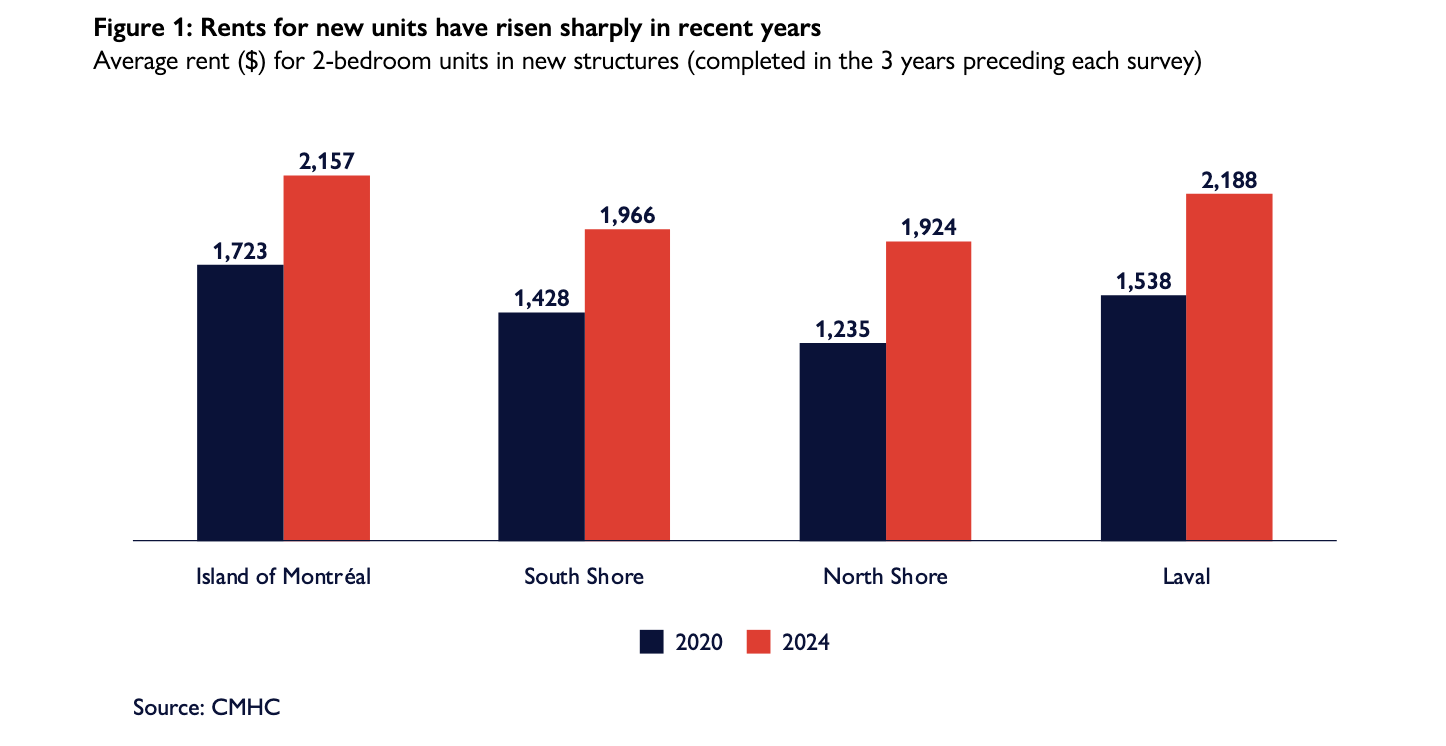
The poor management of the CAQ of the housing crisis has led to the largest increases in asking rent in modern Quebec history, and people are struggling to make ends meet. They put a moratorium on renovictions, but this has not actually stopped it from happening. Landlords can use loopholes to throw people out, despite the moratorium.
Since the CAQ was elected in 2018, housing prices across the province have increased by 63 per cent. In Montreal it’s increased by 120 per cent.
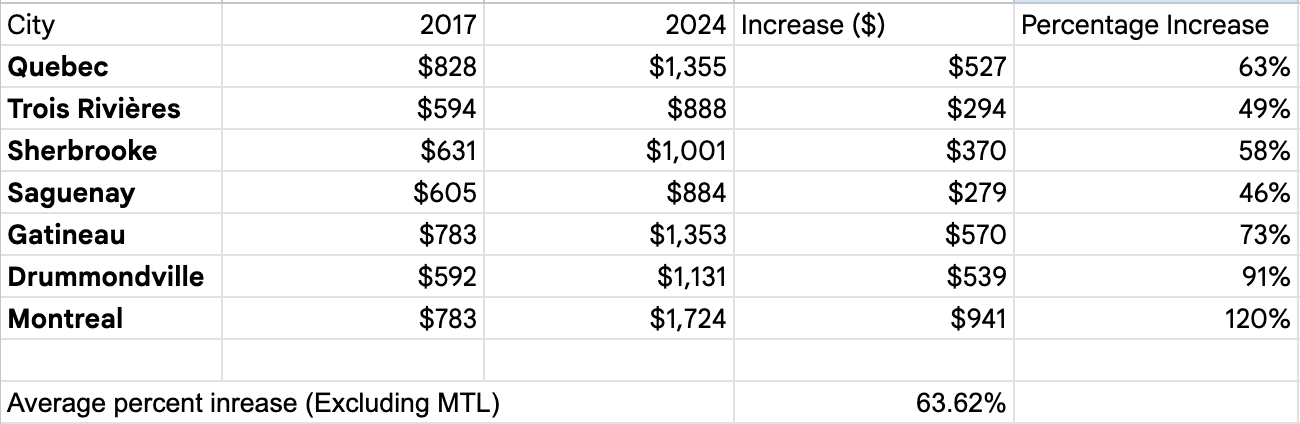
The TAL, Quebec’s administrators for housing disputes in Quebec, prioritizes landlords and is weighted in favour of landlords. For more information on the crisis, I highly recommend listening to mine and Gabrielle’s housing podcast & articles, available in both French (articles, podcast) and English (articles, podcast).
Economy and Deficit
As I’ve stated in other articles, deficits are not as important as the political class wants people to believe, but it is a sign of how people are governing. Specifically, and somehow not talked about, the CAQ transferred wealth upwards to the wealthiest while defunding our systems. They did this by implementing one of the largest tax cuts in Quebec’s history, while implementing austerity measures for public services.
In an article from Pontiac Journal quoting IRIS, an economic research group, “people earning up to $100,000 annually will receive a tax break of just over $800 per year, whereas those earning $50,000 will only save $328. Essentially, this means that no gain will be made by taxpayers with incomes in the lowest tax bracket, which represents 35% of the Quebec population. Guillaume Hébert, an IRIS researcher and co-author of the study, expressed his concern stating that “these tax cuts will benefit the people who do not need them.” (Pontiac Journal, Tashi Farmilo)
These tax cuts not only benefitted those who are making more, it also cut $9.2 billion dollars from the Quebec treasury while Quebec is short thousands of teachers and our health care system is barely surviving.
Legault promised balanced budgets and lower costs for Quebecers, but the government failed in this regard. Every year the deficit exploded, and instead of raising taxes and making the wealthy pay their fair share, they irresponsibly used the Quebec Generations fund to pay for extra costs. In 2025-2026 the budget reached $13.6 billion.
Quebecers then saw revenue stagnate as inflation set the economy on fire.
Quebec, in 2025, had their credit rating downgraded. A worsened credit rate cyclically increases the cost of borrowing for the government. Thus, the deficit and costs to the Quebec treasury are inflated even more.
The CAQ ran on a platform of economic stewardship and growth, something that they claimed were ignored by the Liberals and PQ for far too long. Instead of being efficient and enriching Quebecers, the population is in a worsening crisis with no end in sight. The legacy of the CAQ will not be that they walked away with a wealthier Quebec, but they left Quebec’s finances in tatters– failing to fulfill their raison d’être.
Scandals. Endless Scandals.
The CAQ had wall to wall scandals during their second mandate.
Northvolt
Quebec purchased $420 million dollar stakes in Northvolt in order to build the EV battery manufacturing plant in Quebec. They cited Quebec’s clean power grid as a way to cut emissions in half for EV battery manufacturing versus the United States. The project hardly got underway before the scandals and controversies started.
While saying it would be the dawn of Canada’s green energy supremacy, the Quebec government didn’t mandate an independent environmental evaluation by BAPE. This seemed to be the result of minister Fitzgibbon meeting with the Northvolt co-founder. The CAQ denied the allegations.
Protests followed because the location for the site was on Quebec’s wetlands. Rudimentary bombs were created and placed underneath construction vehicles, but were found before they were ignited.
Things went quickly afterwards. Fitzgibbon stepped down, Northvolt seemed on the brink of collapse, and all of a sudden declared bankruptcy. They had $6 billion in debt, and $5.4 million dollars in cash left. They abandoned the site, abandoned the work, and Quebec lost $270 million in investments total, but recovered the $200 million value land site.
SAAQCliq
Transforming the nation’s automobile society was a necessary step to take, but the CAQ was not up to the task. The digital transformation was budgeted to cost $500 million. It cost $1.1 billion and didn’t work. The platform, buggy, unusable, went more than two times over cost. The Gallant commission was created to investigate.
When the platform launched, the government knew it wasn’t ready. The auditor general called it “a total failure”. The Gallant commission found corruption and mismanagement across the board, with a report coming out on January 15th saying Geneviève Guilbeault and her team gave testimony that was unreliable during their interviews.
The Third Link
After running a successful campaign on the third link during the 2022 election, the CAQ abandoned the idea outright. It became what is known as a “zombie project” because it simply would not stay in its grave.
By late 2025, the government had spent $46 million on engineer studies, with geotechnical drilling underway, but no final cost estimate or construction timeline had been confirmed. It alienated voters on both the South Shore (who wanted a car link) and in the city (who opposed urban sprawl), contributing directly to the CAQ’s polling collapse in the region. Soon after, they lost a byelection in the area.
Desperate identitarian ploys
Target the Muslim women
I have written & published quite a bit about muslim women in Quebec being targeted for no damn reason.
The CAQ reached a new consensus on Laïcité in the province as they banned religious symbols in public sector work, and prayer in the streets. Both these things were clearly targeted against muslim women.
Nonetheless, despite the fact that this demonstrates a lack of understanding of what the term ‘secularism’ means, Quebecers largely approve of these measures.
Get rid of anglos & immigrants
The CAQ makes René Levesque look soft on anglophones.
The charter on the use of languages in the province has made it harder than ever to access services in English, with every government website hilariously having a little link at the top that says “if you’re not a historical anglophone, stop reading in english and switch to french plz”.

They increased out of -province tuition to English universities, nearly doubling the cost– then backing down and only increasing it by 33 per cent, despite a judge telling them they couldn’t even do that.
This resulted in an immediate drop in enrolment for both McGill and Concordia.
Concordia: Reported a 37% drop in applications from outside Canada and a massive deficit.
McGill: Reported a 22% decline in applications and initiated a hiring freeze.
Ironically, French universities also suffered collateral damage, with international enrollment at the Université de Sherbrooke dropping by 58%.
They removed the Quebec Experience Program without a grandfather clause, leaving immigrants on working visas without jobs and in dire straits.
Legault has also done his best effort to demonize immigrants as a diversion from his government’s failings, saying that the housing crisis is “100% the fault of temporary immigrants”. He has worked to make Quebecers believe that all of our social services failing are the fault of immigrants, something which Paul St Pierre Plamondon has picked up and is weaponizing.
Corner a dog in a dead-end street and it will turn and bite
I don’t mean to be that guy, but Sun-Tzu said “Don’t press a desperate foe too hard.” Legault is a perfect example of a man with nothing to lose escalating because there was nothing left to lose.
The last gasps of the CAQ government resulted in the darkest moments of their government. In the fall of 2025, Legault and his team redoubled their efforts to bring back the haunting legacy of Duplessis.
The faux Quebec constitution, introduced with no consultation, and no amendment clause, wouldn’t be applicable in the province because it is subject to the Canadian constitution.
It endangered women’s right to abortion, and it removed fundamental freedoms. It bars anyone from taking the government to court over laws enacted “in the national interest”. I highly encourage watching my interview with Fred Berard on it.
Women’s rights groups had been contacted by Simon Jolin-Barrette as he was preparing the document, and they asked him not to include anything on abortion. He ignored them. This opens the door to abortion rights being removed by future, anti-abortion governments.
Legault “declared war” on the unions of the province. It went poorly. I cover unions extensively. Legault has consistently lost to unions across his whole mandate. Still, he’s done a lot of damage.
Legault attempted to reform how doctors are remunerated. The backlash was severe, and Legault lost the fight in spectacular ways, with many analysts on Radio Canada and TVA saying he “bent the knee.”
Bowing out
Legault leaves Quebec more divided and in significantly worse shape than when he started ruling. There doesn’t seem to be a leader on the horizon who would prioritize the well being of Quebecers.
The next election has been thrown into disarray with the resignation of Pablo Rodriguez and Francois Legault. The results are not guaranteed, since PSPP has a deft ability to shoot himself in the foot because of how emotional he is.
This year in Quebec politics is certain to be interesting. We are yet to see whether the young leaders of every party are willing to confront the backsliding that Quebec has faced in the past decade.
With the province returning to a Duplessis-like state, who will lead Quebec after this year’s election? Will they be willing to make hard decisions to restore trust in Quebec’s world famous institutions? Or will they demonize immigrants, and defund the state?
Only time will tell.
Horrible state of affairs, so cruel. I am now involved in the new Collectif de lutte contre l'islamophobie, such distress among the sacked women. All of this makes me want to puke and cry at the same time.
Unfortunately, politicians are thankful to Lego for the immigrant scapegoat. This cat is out of the box, there's no turning back.