


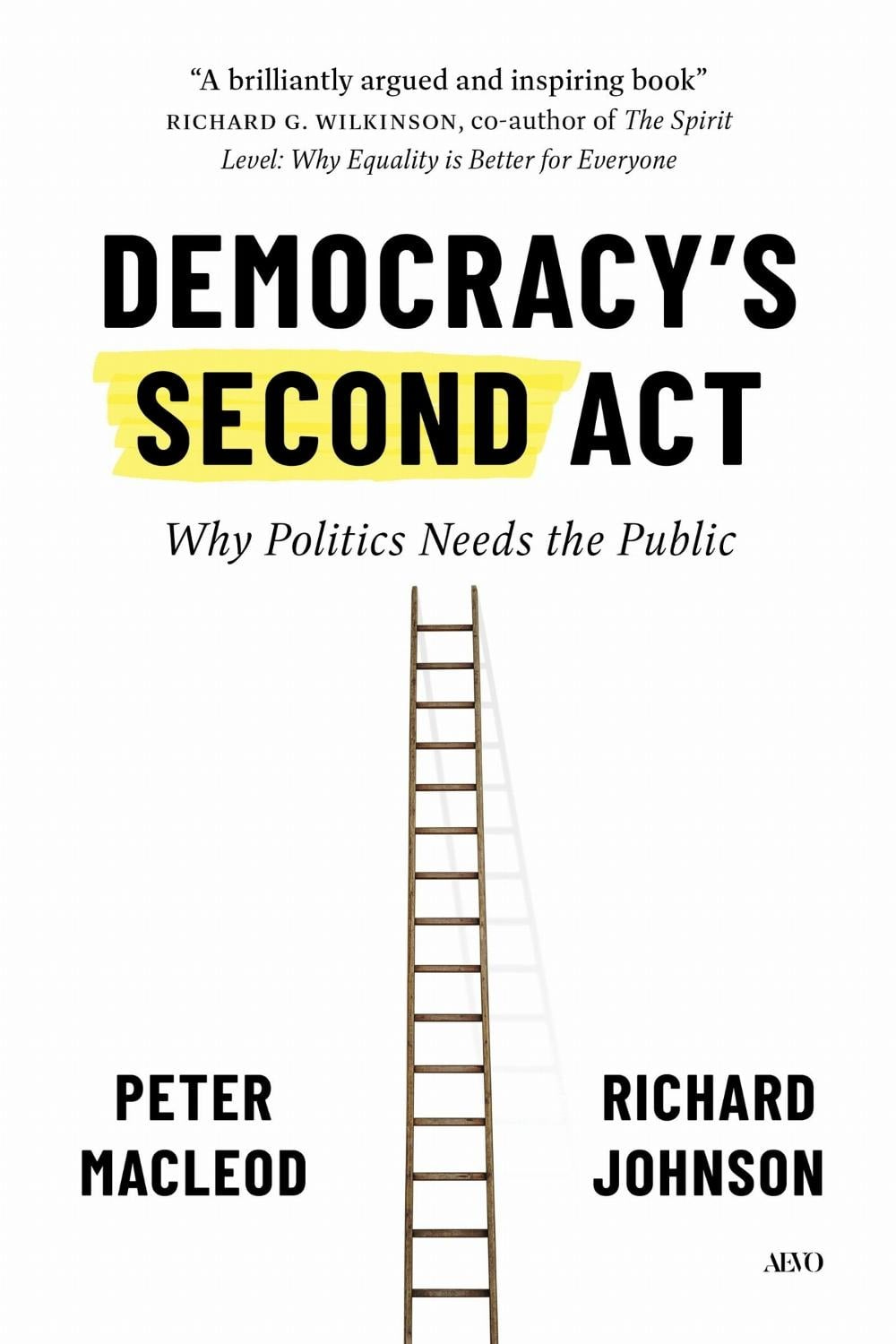
Democracy’s Second Act came out recently, a book by Peter MacLeod and Richard Johnson. You can purchase it here. I make no money off of your purchase. I asked, and received a review copy of the book because I thought it could be an important one.
The book doesn’t seem to be making waves in the political world. I think I know why.
The main thesis of the book: Democracy is more than a vote, and to secure it we need to have regular people more involved in every aspect of the process. At least that’s my takeaway.
The book is good, but it isn’t great. It lacks a strong conclusion, with suggestions on creating “democracy’s second act”, despite spending the whole book showing examples of what it thinks democracy needs to do. It expects the reader to extrapolate and invent these ideas. Fair enough. It is a book about
Still, I found it missed out in having the impact it could have, because the book doesn’t have a target audience. It’s a bit too broad, and failed to highlight problems. It stayed too far back, observing many countries, many places, but it didn’t even zoom in on anything to point out particular flaws with individual democracies, instead highlighting the problem with western philosophy and culture around democracy.
Let’s philosophise in response, because the ideas in the book need to be reckoned with.
Our democracy is broken
The book highlights a big problem. The structure of our democracy is broken; Journalists, activists, & politicians, they’re too close to power, and furthermore, they act as gatekeepers separated from the general populace. This leads to a degradation of trust in institutions.
Journalists are two steps away from power, and tend to gatekeep knowledge and information. We hold the secrets of the country, the universal knowledge that predicts what will occur and we’re only gonna tell you if we feel like it. Yes, journalists often keep power accountable, but with that power, we have a tendency to be arrogant.
Activists get seen as too loud and radical, dismissed by journalists and politicians unless it’s conducive to their own agenda. They feel separate, and are often viewed as important by their little subculture, a leader, and rarely have time out of their constant organizing and fighting for justice.
Politicians are often the elite, at least most visible ones are. The ones who take up the most space tend to be the most elite of the bunch, the wealthy, the long term power brokers.
Meanwhile, the electorate is unable to engage in a meaningful way.
We often tell people to vote, that it’s the greatest expression of our democratic rights. This falls short of true participation. Voting isn’t the great bringer of change, otherwise the electoral system would be truly representative, and the voters would feel more trust in institutions.
The book advocates for citizen committees that can help with major decision making– committees that are reflective of the demographics of the country, selected randomly, and brought together to make significant decisions.
At the core of this idea is a simple truth: Individuals in our society have better ideas than we think.
Still, despite this book’s fantastic premise, it falls short.
Democracy’s Second Act shows how it has been done, but it doesn’t give many concrete examples of how to go further. One of the biggest problems with this book is that it’s a broad overview that isn’t targeted towards any specific country. It believes that we need to trust in the electorate, yes, but because it talks about countries all over the world without the goal of helping one country in specific, it doesn’t present the concrete ideas that are needed to secure democracy’s future.
Otherwise said, it presents a framework, but lacks followthrough.
By giving this power back to the electorate, the book argues, we will be able to renew democracy and decentralize decision making. This will make democracy strong once again.
I don’t not agree, but I also don’t think the book nails the landing. Plus, there’s a problem with its argumentation.
Targeted audience
“At any given moment, public opinion is a chaos of superstition, misinformation, and prejudice… A chaos, we would add, that is regularly exploited by politicians and elites,” it says.
Of course, we know this to be true. But then it replies to its own conclusion by saying “it is incumbent upon states to create the conditions for publics to emerge and be productive.”
The book lives in a paradox, because the same elites and political class who are manipulating the public to its whims are the class who must create the conditions of better public engagement. The same elite who control the power, and drive the country’s machinations are unwilling to return power to the people.
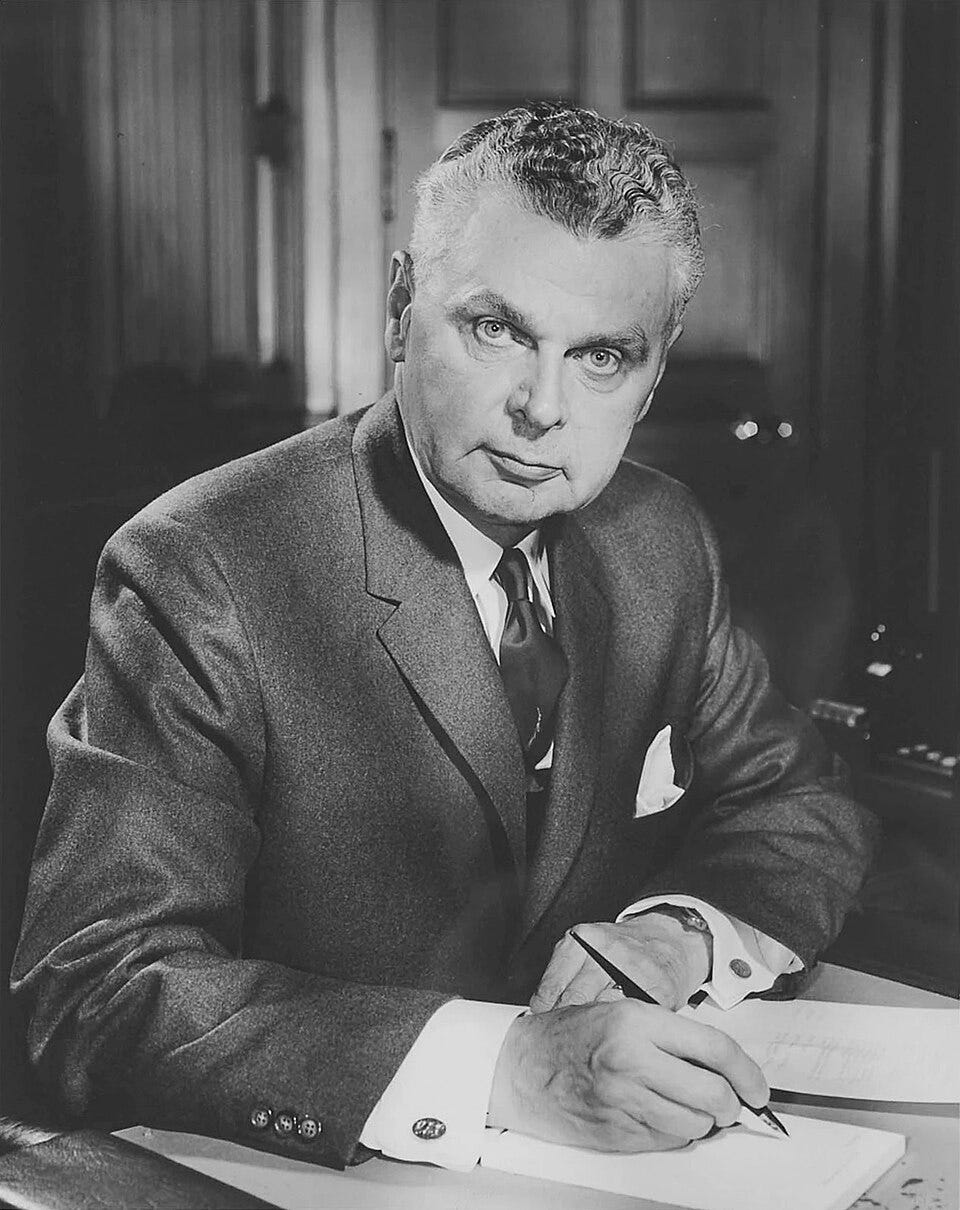
In the 1960s there was a class of politicians who were the bourgeois, but they had ideological views of the world. They wanted to strengthen democracy. Diefenbaker in Canada, and Lyndon B. Johnson in the USA.
The book falls short of truly being great or revolutionary because it doesn’t focus on any one system, or because it doesn’t dissect the particularities of electoral systems in any country.
Without a targeted audience (Canada, Ireland, the USA, etc…) the book won’t appeal to the subject that it highlights– normal people. Canadians might not see themselves in the book. Thus, Canadians might not read it.
But the other target, the ruling class, won’t be interested in the book, because the ruling class is directly criticized in it.
Democracy’s decline
Since the 1980s, there has been a rapid, concerted effort by politicians to centralize power, and refuse any attempt to redistribute it. Since Mulroney, democracy in Canada has been on the decline through a distribution of power towards corporations and moneyed interests– Nora Loretto wrote an entire book about it.
In some ways, Justin Trudeau reinforced our democracy. His government introduced good laws that prevented things such as the government using public money to advertise its own achievements (which Carney recently changed), increasing access to advanced voting, reintroducing the vouching system (making it possible for people without identification to vote), putting harder campaign spending limits (it still favours Liberals and Conservatives), adding polling stations all over the country, making it easier for Canadians living abroad to vote, making the voter identification card an acceptable ID, the list goes on.
On the other hand, he promised electoral reform and then didn’t do it. So, feel as you will about these reforms.
But more than that, he fell prey to the same problems as Chretien and Harper– a single vision, and tight control over the caucus. Carney is the same.
The technocrat vs the demagogue
Carney is the CEO of Canada. I don’t think there is another way to describe him. He doesn’t seem particularly interested in debates of philosophy and questions of democratic strength– he simply wants diverse trade. What’s his solution to our social problems? Trade. What’s his goal for social peace? Trade. How will he fix health care? It doesn’t matter. Trade.
Carney is a one man show. By all accounts in Parliament, Carney is the boss. He’s the smartest man in every room. When he’s around, it’s his vision. He says to his team, “let’s do this,” and they follow suit. He’s the CEO of the Liberals, and thus the CEO of Canada.
But I don’t want to be unfair. Carney’s biggest success isn’t his vision for Canada– it’s that every premier wants to work with him. In fact, this is a great example of Carney’s Liberals improving our democracy.
His cooperative federalism (a term that simply means that the premiers work together with the Prime minister to get work done) is genuinely the strongest point of his leadership so far. It’s Mulroney coded. Mulroney called up the Premiers and met with them all constantly; he was willing to have the fight that many leaders aren’t. Our leaders since then were interested in one thing: rule by pocketbook. The feds have money. If the provinces do what the feds say, they’ll get cash.
Seeing as Canada is the most decentralized democracy in the world, with more or less no ability to change it, working in tandem with the premiers is an important act in Canadian democracy.
But on the other hand, Carney is the most elite of the elite– and he shows it through every action he takes. This is the least efficient parliament that we’ve seen in thirty years. A way to judge efficiency is to look at the number of bills passed by a party. The Carney Liberals have passed 12 bills. Carney’s Liberals are using omnibus bills on a near constant basis– huge, sprawling bills that hide things within their pages so as to avoid scrutiny.
Not only that, but the Carney Liberals are in such a dominant position nationally that they’ve managed to beat the conservatives and NDP into a docile, whimpering opposition. It might be fortunate that they don’t have many domestic policy goals, because the Carney Liberals fear no man.
In this wonderful chart by the CBC, we see how many bills have been passed by each Parliament, and we see how many bills have been passed “on division”.
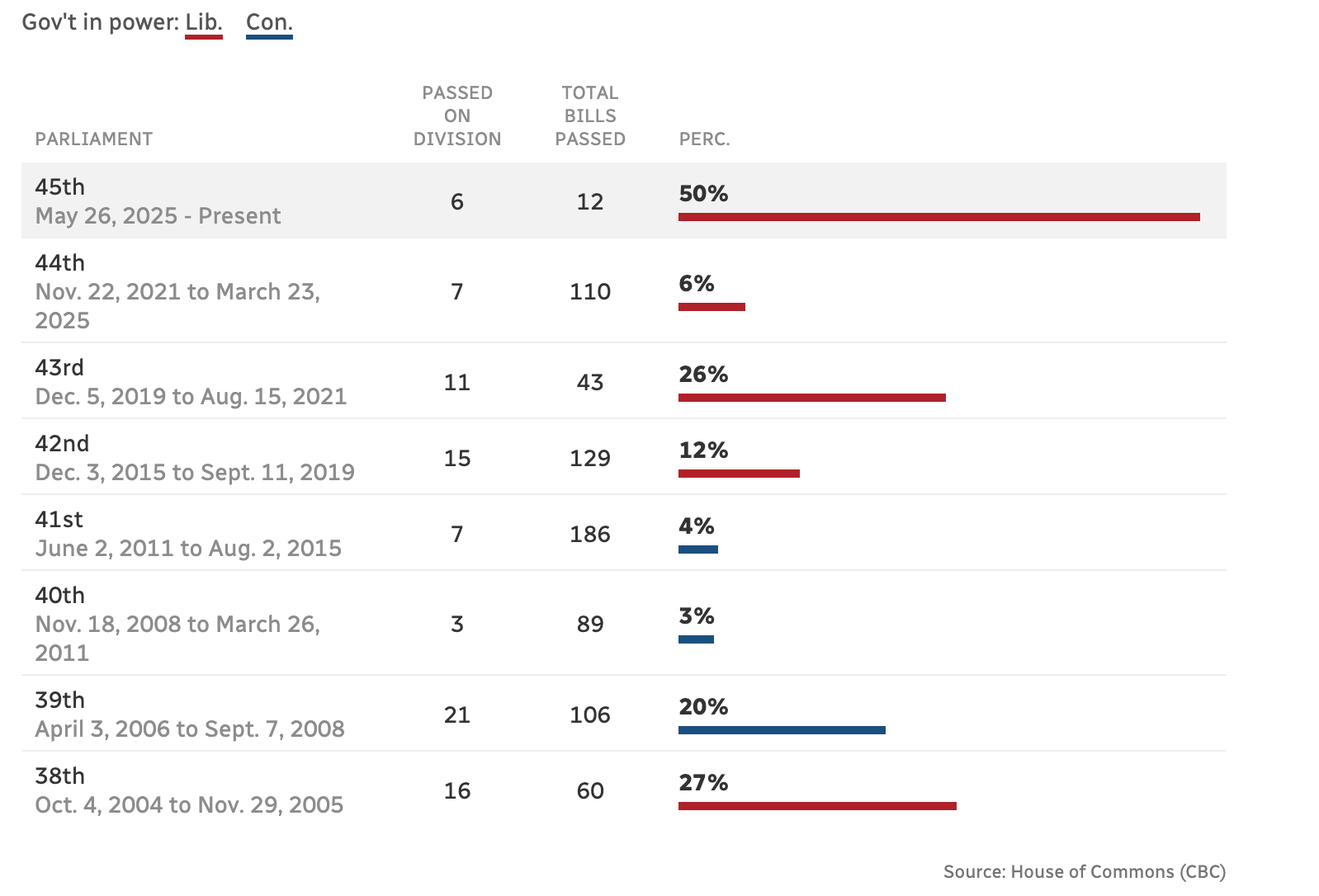
“On division” means that the opposition parties did not record their votes– it means they don’t agree with the bill, but they don’t want to contest it. The Conservatives are horrified by another election, and the Liberals are going to win a majority by attrition (which I believe will be the first time a ruling party has ever won a majority like this.)
If we do some quick math, the 45th Parliament is pathetically inefficient on passing bills. If they continue this rate of passing bills, by the next election in 2029 they will have passed a total of 66 bills. (9.5 months = 1.26 bills per month, multiplied by the remaining months left until the next election, plus 12.)
For comparison, Paul Martin (a technocrat and banker, like Carney) had a minority government and in one year he passed 60 bills, with few of them “on division.” Many have compared the two Liberal leaders, but Carney is nowhere near as efficient or effective as Martin. At least on a completely technical reading.
The Carney Liberals have an absolute power that’s quite remarkable to watch, despite them not often using it. Democracy’s Second Act calls out this type of control and power directly.
“Those who would prefer to see us citizens remain as spectators hold more power and influence than ever– as elitist technocrats and theorists who barely tolerate the public while purporting to steer the sinking ship, but more ominously as autocrats and toxic demagogues who divide people into tribes, stir up outrage and conflict, and whittle away our cherished freedoms, institutions and the very decency of civic engagement– all so they can enrich, entertain, and flatter themselves in the guise of democratic rule.”
Half this quote applies to Carney– “technocrats and theorists”, but it’s obvious that Carney doesn’t divide people into tribes or stir outrage. No, that was Polievre’s thing.
Carney doesn’t tolerate much input from the public. He holds the most influence. He’s already abandoned many aspects of his campaign promises around climate change and housing. He’s changed his tune on many parts of his values that he claimed to have, and he’s moved further and further right as an expression of his own ambition to maintain power for the elite. In fact, the elite and the corporate class are so in tune with Carney that the lobbyist registry has had its most active period since its founding– corporate elites know who’s in charge.
A fine example of his disinterest in external input would be last week, where his communication about Iran divided the Liberal caucus. Althia Raj does a fantastic breakdown of this on Peter Mansbridge’s podcast.
The Liberal caucus was infuriated about Carney’s hints that they might engage in the Iran war, even in Carney’s vague terms. His original communication sided with Trump, which proved to incense the Liberal base, and the caucus. Then he stepped back, because of the backlash. Then he blundered again, saying that we couldn’t rule out participation in the war. Finally, this week, (probably after hearing a lot of anger from his party) he said a clear, full stop, we will never participate in the Iran War.
A lot of pain could have been sidestepped had he said that off the bat. Or maybe had he consulted his team a bit more.
On the other side of Carney was the divider, the tribalist.
Pierre Poilievre was part of the “toxic demagogues who divide people into tribes, stir up outrage and conflict, and whittle away our cherished freedoms, institutions and the very decency of civic engagement”. He intimidated people. He stirred up anger and divided people into tribes, obsessing over conspiracy theories, attacked democratic institutions, didn’t care for democratic accountability, treated journalists with disdain and is possibly one of the greatest reasons for anti-journalist sentiment in Canada. His brand was that of Trump– divide and conquer. Poilievre is by no means a technocrat, but he is an elite. He’s the spearhead of the democratic backsliding seen during Harper’s final mandate.
Canadians chose the technocrat over the demagogue.
They are set to continue doing that, at least in the meantime.
The smartest country on earth?
Canada has the most educated population on earth. And the second highest, Ireland, is a full 7 per cent less than us. This fact can explain a lot about our country.
First, it explains why Canada has elected Liberal governments for 70 per cent of its history. Education systems and their voting are intrinsically linked– A broadly liberal country, with liberal education will lead to a country that votes… Liberal.
During the Davos speech, Carney sounded educated. He pieced together rich sentences as a man who is well read, university educated, and didn’t dumb down his ideas. Canadians are well educated– they hear a well thought out speech which uses a few “philosophisms” that wouldn’t appeal to a less educated population.
He mentions “This aphorism of Thucydides” and he talks about Václav Havel– a common subject of study in universities. Canada’s highly educated population hears that, and appreciates the intelligence and leadership of the man. They relate to this form of thinking. Canadians are intelligent. They’re thinkers.
After the election, we’ve seen Poilievre’s support melt away. The people who are left are partisans– people who believe in the Conservative movement. Ideological people. Since the Conservatives are the only “right wing” party in Canada, they get support from anyone who is ideologically right wing. But Canada’s right wing is tempered by extremely high levels of education. A large portion of Canada’s “right” are close to the centre.
Poilievre gained popularity through a dissatisfaction with institutionalism. Canadians got a front seat view of what anti-institutionalism looks like in the USA, and changed their minds.
Education often breeds adaptability. Many Canadians are swing voters. They’ll vote where they think it best at any given time. Because of our flawed system, Canada often votes Liberals because they’re a relatively safe government, and voting Liberal is pragmatic.
Canadians clearly feel that the Liberals have been doing a pretty good job– and the facts seem to support it. Canada is considered one of the most peaceful countries on earth, with a high standard of living. Seeing as 70 per cent of Canada’s existence has been under the leadership of Liberals, there’s a strong argument that they’re consistently a reliable government.
Their achilles heel remains though: They often succumb to arrogance, and think of themselves as Canada’s only choice. Natural governing party indeed.
In Democracy’s Second Act they argue for citizen committees, and a direct involvement by the electorate. In Canada we have the highest educated population on earth, with the most diverse country in the western world— and no other western democracy comes close, by the way.
Canada is rife with potential to involve its population in governance. Yet, the government tends to ignore the expertise that’s sitting right there.
It’s a shame that this book isn’t making huge waves in the Canadian political world, because the Liberals could take this concept far in practice. But I think that this is the book’s own fault.
Not Targeted
The book is thoughtful and has a good thesis. But it winds up being so broad that it doesn’t quite land. It’s a Canadian written and published book, and it was an easy read. Peter MacLeod and Richard Johnson are good writers, with the nucleus of something good.
Yet the book might not ever see its objectives fulfilled. If this was pointed towards Canada specifically, it might have more impact. If this was pointed towards any country at all, it might have more impact.
Right now, it’s a bit stuck. David Moscrop wrote about the book, and now I’m writing about the book. But there isn’t a Globe article about it. There isn’t a CBC books article. Had this been a more pointed, focused book, I think this could have made a splash.
At a time when Canada wants as much help reinforcing itself against what is happening in the United States, the book would have likely found a lot of success if its principal idea was that individuals in our society have better ideas than we think: Here’s how Canada can do this.
But clearly this wasn’t the goal of the authors. And sadly, that means that this book doesn’t quite stick the landing.
The book is good. The thesis is good. It’s smart. It’s well written. But it falls somewhat flat.
It’s academic, but it isn’t pointed. Ten years ago, this book would have made more sense– but right now we might need more urgency and specifics to secure democracy, because it could slip away at any moment, and I don’t think a citizen committee is going to stop that.
Merci pour cet article. La conclusion est claire, il faudra plus qu'un comité de citoyens pour réenchanter la démocratie au Canada. Vous êtes une vraie ressource pour le décryptage de notre actualité polutique !
Au cas où , la radio belge RTBF et sa série "Les clés“ font des capsules aussi intéressantes que les vôtres, du point de vue d'un petit pays, donc très neutre. Journaliste Arnaud Ruyssen, excellent, ça pourrait vous intéresser ...
https://youtu.be/qNwa1-SMsIU?si=qDXi8-A3bluKp1Ke